
Copper Gutters in Fernandina Beach, FL
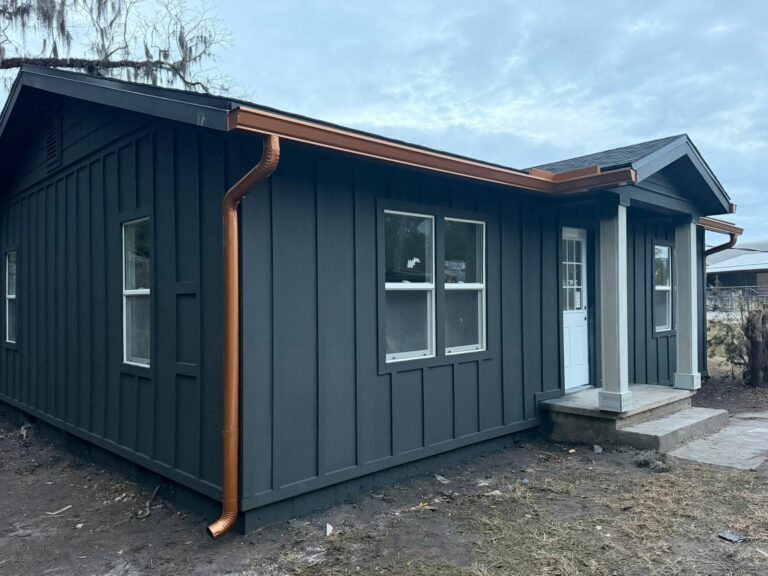
Copper gutters can frame a porch or entry without covering every roof edge. For copper installations in Fernandina Beach, we look at the trim, how each fitting will connect, and where the downspouts can drain.
Where would copper suit your roofline?
Start with the roof edge and trim
Start at the part of the house you see first, such as a front porch or entry. A half-round profile has a curved edge, while a K-style profile has a more pronounced face. Compare both against the trim before you choose.
A porch can be a good place for a copper accent if it has its own roof edge and a practical place for a downspout. If several roof sections feed that edge, we look at the runoff together before deciding what the run needs.
Copper darkens as it weathers. The color may vary across sheltered and exposed faces. If matching the finish matters, compare the roof edge and downspout together in the gutter project gallery.
The profile also needs to fit the support behind it. We look at where brackets can attach and whether the roof edge has enough room for the run to slope toward an outlet.
If parts of the existing system are still sound, you can check which leaks can be repaired before deciding how much to replace.
How should copper gutters fit a historic exterior?
Keep the trim and entry details visible
Draw the gutter and downspout against the visible trim before finalizing either. A round downspout can follow a corner or side wall if the route still gives runoff a suitable place to discharge.
If your home is in a historic district, check Fernandina Beach’s current historic district guidance before changing the exterior. Start with photos of the roof edge, porch columns, and any existing gutters you want to keep.
At the site visit, we check where water from a higher roof reaches the porch or lower roof. That helps us discuss which lengths and corners belong in the same plan.
Ask which brackets, fasteners, and fittings will touch the copper. The quote should say how the installer will handle contact with other metals where it occurs.
If you’re comparing copper with another material, see how we plan gutter profiles and outlet locations in Fernandina Beach.


Where should copper downspouts discharge?
Follow the water from roof to ground
Follow the route from the gutter outlet to a spot where water can drain away from the house. A downspout at an entry can spill across a walkway if the outlet ends too close to it. We check where the pipe can run and what it will discharge onto. If a surface outlet would cross a path or patio, see when a buried downspout line can help.
What belongs in a copper gutter installation quote?
Compare the same runs, fittings, and outlets
When comparing quotes for copper gutter installation in Fernandina Beach, FL, ask each installer to identify the same roof edges, corners, outlets, and downspouts. A quote for the porch alone has a different scope from a quote for the whole roofline.
Check whether the proposal includes removal, the type of brackets, and what happens if the wood behind the gutter needs work. You can also get to know the team that will do the work.
For a closer comparison, ask whether each proposal includes the same finish, gutter profile, and fitting material. Make sure you know where each downspout will end.
For work on the rest of the roof, see the other gutter options we offer in Fernandina Beach.

Can I use copper only on the front porch?
A porch-only copper run can work when that roof edge can drain on its own. We check how the porch connects to the rest of the roof and where its outlet would discharge.
Will the new copper match an older downspout?
New copper usually starts brighter. Compare the existing finish and the exposure on each side of the house before counting on an exact color match.
Can a downspout run beside a porch column?
It can if there is enough room for the fittings and the outlet can discharge safely. Bring a photo of the column and walkway so we can look at the route together.
What should I photograph before asking for a quote?
Take a wide photo of the roof edge and a closer view of the trim and outlet area, from the ground. Include any spots where rain crosses a walk or collects near the entry.
